Understanding 6ms Ishikawa Analysis
Unravel the intricacies of the 6ms Ishikawa method, a pivotal analysis tool in quality management that identifies root causes of issues. Named after its creator, Kaoru Ishikawa, this technique enhances problem-solving efficiency in various industries by categorizing potential causes from Man, Machine, Method, Material, Measurement, and Mother Nature (Environment). Discover the systematic approach that shapes robust solutions in business environments.
Introduction to 6ms Ishikawa
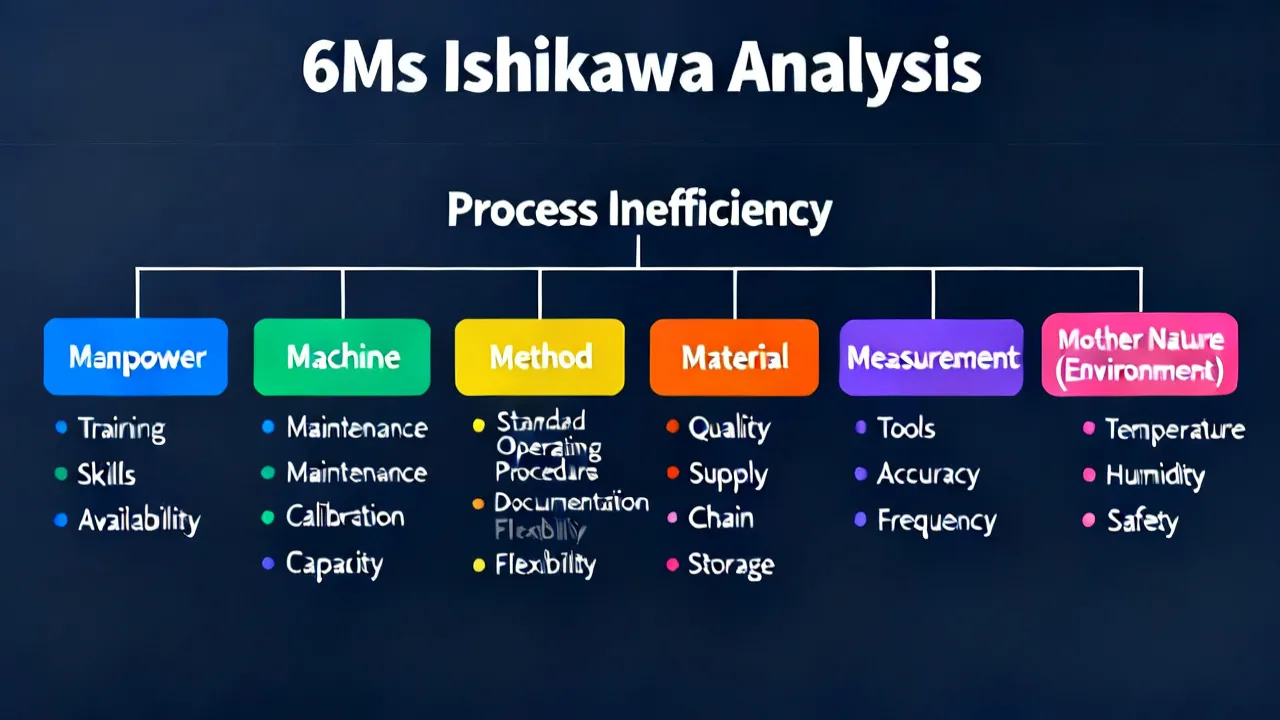
The 6ms Ishikawa analysis is a revered tool in quality management circles, allowing businesses to delve into and dissect the root causes of operational challenges. Originating from the analytical mind of Kaoru Ishikawa, this method is often depicted as a fishbone diagram, helping teams visually strategize and categorize potential causes of problems. By identifying factors related to Man, Machine, Method, Material, Measurement, and Mother Nature (Environment), companies can enhance their problem-solving protocols, leading to sustainable operational improvements. This approach not only focuses on immediate issues but also emphasizes long-term solutions that can prevent reoccurrences, thereby fostering a culture of continuous quality improvement.
Origins and Evolution
Developed by Dr. Kaoru Ishikawa, a pioneer in the field of quality management, the Ishikawa diagram—also known as the fishbone diagram due to its structure—was initially introduced in the 1960s. Dr. Ishikawa's contribution was pivotal in Japan's industrial rise post-World War II, providing a framework that continues to be a mainstay of quality and process improvement initiatives across the globe. The purpose behind his creation was to enable teams to collaboratively identify potential causes of problems rather than focusing solely on blame. This collaborative approach aligns well with the principles of Total Quality Management (TQM), which emphasizes the involvement of all employees in striving for improved processes, products, services, and the culture in which they work.
The Six Elements Explored
In the context of the 6ms Ishikawa, the six causes typically addressed include:
- Man: This category includes human factors and workforce-related issues, such as skill level, training, and workforce dynamics. A skilled workforce is essential for efficiency and effectiveness in any operation, and addressing human factors can lead to significant improvements in productivity.
- Machine: This category analyzes equipment and technology impacts, identifying how machinery efficacy affects operational execution. Regular maintenance and technological upgrades are critical to avoid malfunctions that can disrupt production schedules.
- Method: It examines processes and methodologies to ensure they are reliable and efficient. Standard Operating Procedures (SOPs) must be clear and current to prevent errors and inefficiencies in work processes.
- Material: This addresses the quality and sourcing of materials, and how they contribute to the end product. The reliability of suppliers and the quality of inputs significantly impact the final output, making robust material management essential.
- Measurement: This category focuses on the accuracy and reliability of measurements, which are crucial in ensuring consistent quality standards. Implementing reliable measurement systems within production lines aids in quality control, helping to identify deviations early in the process.
- Mother Nature (Environment): This element considers environmental influences, including regulatory changes and climatic conditions. Companies must adapt to external pressures such as environmental regulations and market fluctuations caused by environmental factors.
Application in Industry
The 6ms Ishikawa method is extensively used across various industries, demonstrating its versatility and effectiveness. For instance, in the automotive industry, it is crucial for diagnosing production line anomalies, allowing teams to quickly identify faulty components or process failures. In healthcare, it aids in the analysis of procedural errors, helping medical professionals pinpoint areas of risk and improve patient safety. Outside of manufacturing and healthcare, service sectors such as finance and customer service have utilized the 6ms Ishikawa to address issues ranging from policy compliance to customer satisfaction. Overall, this method fosters a proactive approach in identifying and mitigating risks, thereby enhancing operational resilience.
Real-World Case Studies
Several companies have reported significant improvements using the Ishikawa method, providing powerful testament to its applicability and effectiveness:
For instance, a leading electronic goods manufacturer revealed a 20% reduction in production defects after a thorough analysis using the fishbone diagram. By categorizing issues into the 6ms framework, they identified specific root causes related to Machine and Material that had not been addressed previously, allowing for targeted interventions to rectify inefficiencies.
Similarly, a food processing firm identified a bottleneck in their supply chain, which was mitigated by addressing issues highlighted under the Measurement category of the analysis. They realized that their data collection methods were inconsistent, which led to poor inventory decisions. By standardizing their measurement procedures and ensuring accurate data capture, they were able to streamline their supply chain and significantly improve operational efficiency.
In the healthcare sector, a hospital utilized the Ishikawa diagram to analyze reasons for patient wait times in emergency rooms. By organizing feedback and insights from various departments, they uncovered that the Method used for triage was outdated, leading to longer wait times. With this knowledge, they were able to implement new protocols that reduced patient wait times by 30%, dramatically improving patient satisfaction in the process.
Implementing the Ishikawa Method
Implementing the 6ms Ishikawa approach involves several key steps, ensuring that the analysis is thorough and comprehensive:
- Formulate a clear problem statement: The first step is to define the problem succinctly. This is crucial as it sets the focus for the entire analysis.
- Assemble a cross-functional team: Involving members from different departments brings diverse perspectives and expertise, promoting comprehensive exploration of potential causes.
- Construct a fishbone diagram: Centralize the problem at the 'head' of the fish. This visual representation allows everyone to see the problem in context of the contributing factors.
- Brainstorm and categorize potential causes: Encourage participants to share potential causes without judgment, categorizing them into the 6ms categories, which fosters a structured approach to problem-solving.
- Analyze and investigate each category for root causes: Deep dive into each category to identify root causes. Tools such as the 5 Whys can be helpful here, as they promote deeper questioning that leads to root cause analysis.
- Implement solutions as appropriate: Once root causes are identified, take corrective action and monitor the results to ensure effectiveness. Continuous evaluation is vital to adapt strategies as necessary.
Comparison Table of Elements
| Element | Focus | Example Issues |
|---|---|---|
| Man | Human Factors | Insufficient training, poor communication, lack of employee engagement |
| Machine | Equipment Efficiency | Malfunction, improper maintenance, outdated technology |
| Method | Process Efficacy | Outdated procedures, lack of standards, inefficiency in workflow |
| Material | Quality Sourcing | Subpar materials, unreliable suppliers, incorrect specifications |
| Measurement | Data Accuracy | Inaccurate metrics, calibration errors, lack of standardized measurements |
| Mother Nature | Environmental Factors | Regulatory changes, climatic impacts, unforeseen environmental circumstances |
FAQs
Q: What is the primary benefit of using the 6ms Ishikawa method?
A: The primary benefit is its ability to identify and categorize the root causes of issues systematically, thereby facilitating effective solutions and improvements. This structured method encourages team collaboration, promoting a culture of continuous learning and adaptation within organizations.
Q: Can this method be adapted for sectors outside of manufacturing?
A: Absolutely. Its versatility allows application across various sectors, including healthcare, education, and service industries, among others. Each sector can tailor the method to address its specific challenges effectively, enhancing overall process improvement efforts.
Q: How often should an organization employ the Ishikawa method?
A: Organizations are encouraged to use the method whenever they encounter complex operational challenges that demand a structured analysis of potential causes. However, regular training sessions and team workshops can also be beneficial in instilling the 6ms Ishikawa methodology as a habitual practice for continuous improvement.
Additional Tools and Techniques
While the 6ms Ishikawa method is robust on its own, it can be even more effective when combined with other tools and techniques in quality management. Some of these complementary methods include:
- 5 Whys: This technique involves asking "why" multiple times (typically 5) to drill down to the root cause of an issue. It is simple yet effective, acting as an excellent follow-up to the 6ms Ishikawa analysis.
- Pareto Analysis: Also known as the 80/20 rule, this tool identifies the most significant factors causing the majority of problems. It can help prioritize which causes to address first based on their impact.
- Flowcharts: They help visualize the workflow and processes, allowing for identification of steps where errors or inefficiencies may occur. They can be used to illustrate processes that fall within the Method category of the Ishikawa analysis.
- SIPOC Diagrams: An acronym for Suppliers, Inputs, Process, Outputs, and Customers, SIPOC diagrams help outline the key elements of a process in a high-level view. They can be instrumental in clarifying the scope of the Ishikawa analysis.
Integrating 6ms Ishikawa with Continuous Improvement Practices
The 6ms Ishikawa method aligns seamlessly with concepts derived from total quality management (TQM) and continuous improvement frameworks such as Six Sigma, Lean, and Kaizen. Integrating these methods can lead to a holistic approach to operational excellence.
For instance, in a Lean environment, the focus is on eliminating waste. Using the 6ms Ishikawa alongside Lean principles can help identify wasteful practices or processes that stem from poorly defined methods or untrained staff. In contrast, when integrated with Six Sigma, which heavily emphasizes the measurement and statistical analysis of performance, the 6ms Ishikawa approach complements the quantitative focus by providing a qualitative assessment of all contributing factors to a problem.
Likewise, Kaizen, which emphasizes continuous improvement through small, incremental changes, can use insights gained from the 6ms Ishikawa analysis to fuel its initiatives. Regular application of the Ishikawa method in Kaizen events can pinpoint areas that require adjustment and refinement, ensuring that the changes made are data-informed and relevant.
Challenges and Considerations
While the benefits of implementing the 6ms Ishikawa method are numerous, organizations must be aware of potential challenges that can arise:
- Resistance to Change: Employees may be resistant to new processes, especially if they are accustomed to existing methods. Building a culture of openness and communication is vital to mitigate this.
- Lack of Data: Accurate data is the foundation of effective analysis. Organizations may struggle with data collection and management, which can impact the effectiveness of the Ishikawa analysis.
- Insufficient Training: To fully harness the potential of the 6ms Ishikawa method, team members must be well-trained in its application and principles. Organizations should invest in training programs to ensure a knowledgeable workforce.
- Limited Scope of the Analysis: Sometimes teams may inadvertently limit their analysis to visible or superficially pressing issues, neglecting deeper-rooted causes. Encouraging comprehensive discussion and collaboration is necessary to prevent this pitfall.
Conclusion
In conclusion, the 6ms Ishikawa method represents a powerful and adaptable approach to problem-solving within various organizations. By systematically analyzing components related to Man, Machine, Method, Material, Measurement, and Mother Nature, teams can uncover valuable insights that lead to root cause identification and resolution. Its implementation fosters a structured yet collaborative environment where diverse perspectives contribute to innovation and improvements. As organizations continue to navigate increasingly complex operational landscapes, the 6ms Ishikawa method provides a vital framework that aids not only in immediate resolution of issues but also in building a culture of continuous quality enhancement. By integrating this methodology with other quality management practices, organizations can develop a comprehensive and sustainable approach to operational excellence.
-
1

Maximizing Benefits of Solar Panels: Costs and Energy Efficiency
-
2
Maximizing Your Purchase: Ram 1500 Deals and Towing Capacity
-
3
Affordable Stair Lifts for Seniors: A Comprehensive Guide
-
4
The Ultimate Guide to Lab-Grown Diamonds: Ethical & Cost-Effective Choices
-
5
The Ultimate Guide to Weight Loss Injections, Metabolism, and Appetite Suppression